
How to Gender-bend Your Style — A Guide to Cross-Dressing at the Thrift Store
cross-dressing (noun) : The practice of wearing clothes usually worn by a different gender
The idea of gendered clothing, much like the patriarchy, has been around for thousands of years. This isn’t merely coincidental, as the two foundational tenets of 'western' patriarchy simply put are that:
there are only two distinct categories of human (man and woman) and;
they should inherently be treated differently
Gender can be a very hard set of boxes to place our species into on a genetic level, let alone a physical one. It therefore comes as no surprise that clothing has become one of the most ubiquitous tools used to categorise and label ourselves, and each other. In many ways, the enforcement of patriarchy hinges on being able to easily separate men and women. In all but the least conservative of our spaces, there are noticeable consequences for going against the grain. Those who cross-dress – particularly men choosing to wear what is typically considered “feminine” clothing – are looked down upon, and often have their gender-expression invalidated simply due to their choices in fashion.
So, outside of theatre and drag shows, openly wearing clothing made for the “opposite gender” is not mainstream at all.
Or is it?
As those of us who go thrifting know (and, well, you're reading Fresher so that probably includes you) sometimes the section you’re typically expected to shop in just doesn't have what you're looking for, and you explore another. If so, congratulations! Just like me, you may be cross-dressing.
CROSS-DRESSING - a system
Gender in clothes depends a lot on what’s around it. Take a white, flowery blouse. Pair it with structured pants, a belt, and some nice boots, and suddenly it reads as a soft masculine shirt. Clothes designed for the “opposite gender" usually push a whole outfit into a more hyper-masc or hyper-fem space, but the pieces around them can just as easily pull that back toward androgyny.
Really, it's less push-pull, and more of a “yes, and” relationship.
Tuck that blouse into masculine pants and it suggests a masculine shirt, but the florals don’t disappear, continuing to add softness and texture to what would otherwise be a more straight-lined, minimalist “pure masculine” outfit.
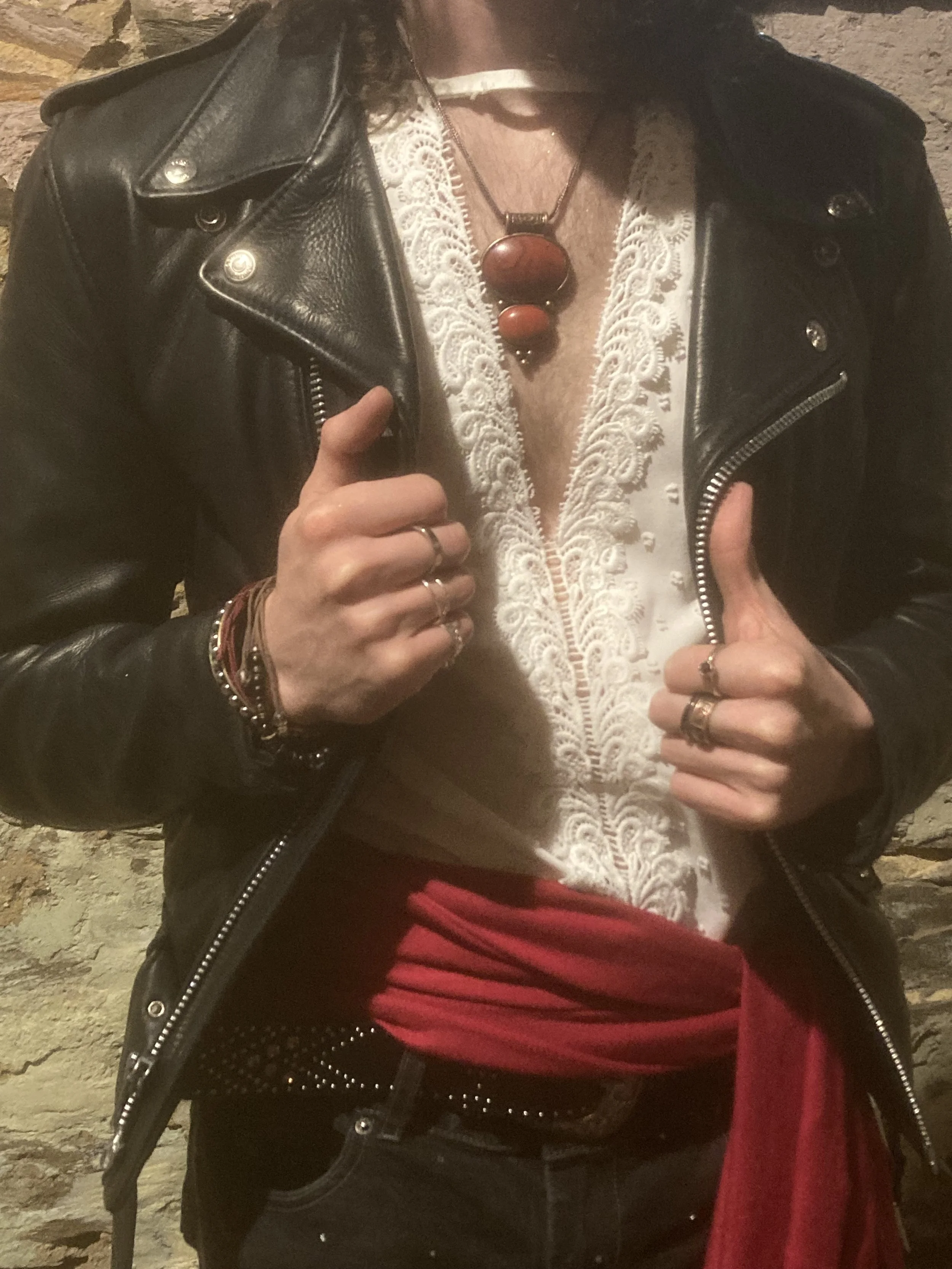
For those who are new to the concept, I'd recommend starting with a singular piece of clothing you’re thinking about adding. What are its attributes, and how would it read on you by itself? Does it push your look to be more masculine or feminine? Now picture it with an outfit you’d normally wear. What does it add, and how does it sit next to everything else?
Think of it like this: every piece you own has its own colour, putting it down somewhere on the scale between masculine and feminine (let’s say M is blue and F is red.) You can even have pieces that are masc or fem in a different direction (for example, lumberjack flannel vs army jacket masculinity). Mix a few pieces together, and all their colours show up in the outfit at the same time, creating a kaleidoscope of colour. Swap out even one piece, and you can add a new colour, and push the outfit in a completely different direction.
Feminine silhouettes provide an interesting juxtaposition to the straight lines of typically masculine garments, adding dimension to the overall figure (á la Will Turner in Pirates of the Caribbean). Women's clothing also gives you more room to play with, spanning everything from tailored trousers, to skirts and delicate tops.
They’re not entirely without issues however, and garment size is a big one. At 5 '11 I’ve found that women's shirts and jackets often run short in the arms, the torso, or across the chest. Pants tend to do the same. If you sit down and your ankle shows above the shoes, they’re too short, so I recommend sticking to boot-cut or flared styles that are much more forgiving.
Pockets are the other constant struggle. Most women’s pants fit a phone and a set of keys at best, or don’t have pockets at all, as many are fake or purely decorative. If you’ve ever worn them, you already know this particular flavour of rage. My advice would be to pack your things into a jacket, or functionally accessorise with a purse or satchel.
A WORD FROM AMBER ON WEARING MEN’S CLOTHING
It's a more recent phenomenon that masculinity is synonymous with shapelessness, when historically it has been the opposite. Masculinity in the 20th-century was tailored; pressed pants, collared shirts, blazers. You name it, anything tailored and form fitting was masculine. There is, of course, nothing wrong with baggy Coogi sweaters and oversized leather jackets but playing with masculinity in your wardrobe is more than just hiding your natural body shape.
So wear some loafers with a miniskirt, or a blazer jacket over a slip dress, some pressed pants with a fitted camisole. Perhaps you already do these things, so let me officially welcome you to the club. I bet you weren't expecting the office siren trend to make you a crossdresser. To have fun with fashion, means to have fun with all types of fashion. So crossing the gender boundary opens up a world of possibilities to liven your wardrobe and experiment with style beyond the confines of tradition.
Conclusion…
Ultimately, there are many different lenses through which we can view our outfits, and gender is one with huge potential for variety and exploration! Actively challenging gender roles and being keen to experiment can open up so much in terms of outfit variation, and help you look even more fashionable than before! Hopefully this article helped you see clothing, and crossdressing in general, in a different light, and if you end up using any of these tips to mix in gendered clothing to your outfit, you’re guaranteed to find some interesting outfits that are guaranteed to develop your personal expression, elevate your style, and turn so many heads.
Bibliography:
“Cross-Dressing.” 2026. In Cambridge Advanced Learner’s Dictionary and Thesaurus. Cambridge, England: Cambridge University Press. https://dictionary.cambridge.org/dictionary/english/cross-dressing.
Featuring a word from Amber Lomax, Editor-in-Chief